Inferno
The Broken Rocks. Pope Anastasius. General Descrip- tion of the Inferno and its Divisions.
On the edge of a towering cliff
formed by massive rocks broken in a circle,
we came upon an even more savage crowd.
There, because of the horrible
excess of stench thrown up from the deep abyss,
we pulled back behind the shelter
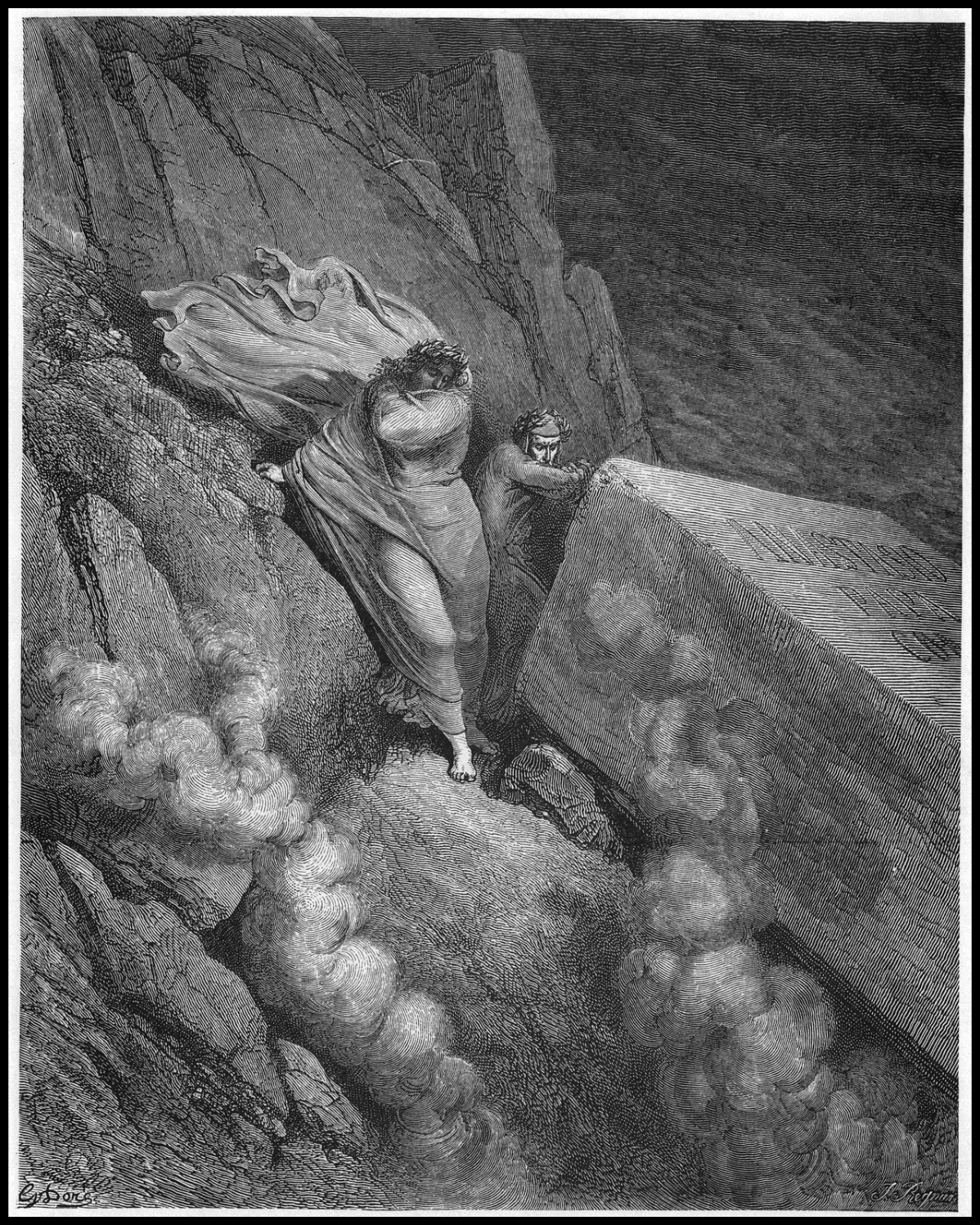
of a great tomb, where I saw an inscription
that read: "I hold Pope Anastasius,
whom Photinus led from the righteous path."
View larger
THE TOMB OF ANASTASIUS
“we pulled back behind the shelter / of a great tomb, where I saw an inscription / that read: "I hold Pope Anastasius,”
"We must descend slowly," my Master said,
"so our senses can first grow accustomed
to this foul wind, and then we won't notice it."
I replied, "Find some way to make the time worthwhile
so it doesn't pass in idleness."
And he said, "You see I'm already thinking of that.
My son, inside these rocks,"
he began to explain, "are three smaller circles,
descending grade by grade, like those you're leaving.
They are all filled with cursed spirits,
but so that sight alone will suffice you later,
hear how and why they are held in torment.
Every evil that earns heaven's hatred
has injury as its goal, and every such goal
harms others through either violence or fraud.
But since fraud is humanity's particular vice,
it displeases God more—so the fraudulent
stand lowest, and greater anguish strikes them.
The first circle belongs entirely to the Violent.
But since violence can be used against three kinds of victims,
it is divided and built in three rounds.
We can use force against God, ourselves, and our neighbors—
against them and their possessions,
as you'll hear with clear reasoning.
Violent death and painful wounds
are inflicted on our neighbor, and on his property
come ruin, arson, and harmful extortion.
So murderers and those who strike unjustly,
plunderers and robbers—the first round
torments them all in different groups.
A person can lay violent hands on himself
and his own goods. Therefore in the second round,
those who deprive themselves of your world
must repent without hope—
those who gamble away and waste their wealth,
weeping where they should have been joyful.
Violence can be done to the Divine
by denying and cursing Him in the heart,
and by scorning Nature and her gifts.
For this reason the smallest round
seals with its mark Sodom and Cahors,
and all who speak contempt of God from the heart.
Fraud, which stings every conscience,
can be practiced on those who trust
and on those who place no confidence in you.
This second kind seems only to sever
the bond of love that Nature creates,
so in the second circle nest
hypocrites, flatterers, sorcerers,
falsifiers, thieves, those who sell holy offices,
pimps, grafters, and similar filth.
The other kind of fraud destroys both
the love that Nature makes and the added trust
from which special faith is born.
So in the smallest circle, at the very point
of the Universe where Dis sits enthroned,
all traitors are consumed forever."
"Master," I said, "your explanation is clear enough
and well distinguishes this pit
and the people who inhabit it.
But tell me—those in the muddy marsh above,
driven by wind, beaten by rain,
clashing with such harsh words—
why aren't they punished inside the red city
if God holds them in his wrath?
And if he doesn't, why do they suffer so?"
He answered, "Why does your mind wander so
from its usual sharpness?
Or where else are your thoughts straying?
Don't you remember those words
in your Ethics that thoroughly discuss
the three dispositions Heaven cannot abide—
Incontinence, Malice, and mad Bestiality—
and how Incontinence offends God less
and draws less blame?
If you consider this teaching well
and recall who those souls are
undergoing penance up outside,
you'll clearly see why they're separated
from these criminals, and why divine Justice
strikes them with a gentler hammer."
"O Sun who heals all troubled vision,
you satisfy me so when you explain
that I love doubting no less than knowing!
Turn back once more," I said,
"to where you said that usury offends
divine Goodness, and untie that knot."
"Philosophy," he said, "teaches those who heed it—
not in one place alone—
how Nature takes her course
from Divine Intelligence and its craft.
And if you read your Physics carefully,
you'll find after just a few pages
that human art follows Nature as closely as possible,
like a student following a master,
so that your art is, as it were, God's grandchild.
From these two sources—Nature and Art—
if you recall Genesis at the beginning,
humanity must earn its living and advance.
But since the usurer takes another path,
he scorns both Nature herself and her follower,
placing his hope elsewhere.
But follow me now, for I want to move on.
The Fishes are shimmering on the horizon,
the Great Bear lies entirely over the northwest wind,
and far ahead we must descend the cliff."