When we crossed the threshold of that gate
which souls misuse through their corrupted love—
making the crooked path appear straight—
I heard it echo shut behind us.
Had I looked back upon it then,
what excuse could justify my failure?
We climbed upward through a fractured rock
that rolled and shifted side to side
like waves advancing and retreating.
"Here we must use some skill," my guide began,
"adapting ourselves now here, now there,
to the receding surface."
This made our steps so infrequent
that the moon's waning disc
had found its resting place and set again
before we emerged from that needle's eye.
But when we stood free in the open air,
where the mountain rises steeply back upon itself,
I was exhausted, and both uncertain
of our way. We stopped upon a plain
more desolate than desert roads.
From its edge that borders on the void
to the foot of the high bank forever rising,
three human bodies laid end to end would measure.
As far as my eyes could stretch their flight,
left and right along the ledge,
this terrace appeared the same to me.
We had not yet moved our feet
when I noticed the embankment all around—
which blocked any right of ascent—
was made of white marble, adorned
with sculptures that would shame
not only master artists, but nature herself.
The angel who descended to earth
bearing news of peace
wept for through many years,
opening heaven from its long closure,
appeared before us carved so truthfully
in such a graceful pose
that he seemed no silent image.
You would have sworn he was saying "Hail!"
For she was portrayed there too—
the one who turned the key
to open the highest love.
Her expression bore these words
stamped clear as any seal in wax:
"Behold the handmaid of the Lord."
"Don't fix your mind on one place alone,"
my gentle master said, positioning me
on the side where people carry their hearts.
I turned my eyes and saw
behind Mary, on that side
where my guide was standing,
another scene carved in the rock.
I passed by Virgil and drew closer
so it would be clear before my eyes.
There in the same marble were carved
the cart and oxen drawing the holy ark—
why one should fear taking unauthorized office.
People appeared in front, divided
into seven choirs, making two of my senses
disagree: one said "No," the other "Yes, they sing."
The smoke of incense
portrayed there made my eyes and nose
argue between yes and no.
Leading that blessed vessel,
dancing with his robes tucked up,
was the humble psalmist king,
and in this he was both more and less than royal.
Opposite, shown at the window
of a great palace, Michal watched him
like a woman scornful and distressed.
I moved from where I stood
to examine closely another scene
that gleamed white beyond Michal.
There the high glory of a Roman prince
was recorded—whose great kindness
moved Gregory to his great victory.
I speak of Emperor Trajan.
A poor widow stood at his bridle
in the posture of tears and grief.
Around him the scene seemed crowded
with knights, and golden eagles above them
moved visibly in the wind.
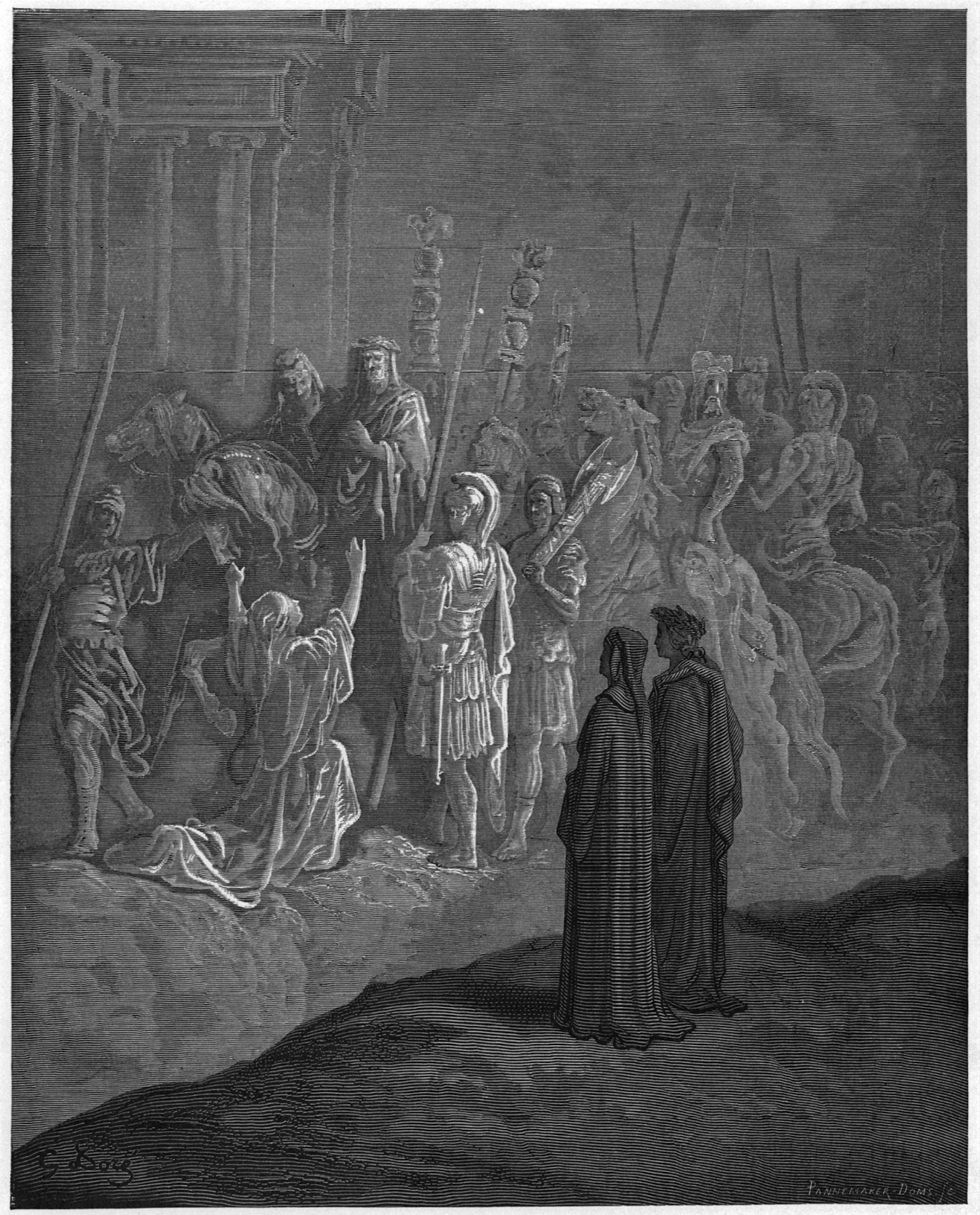
View larger
THE SCULPTURES
“Around him the scene seemed crowded / with knights, and golden eagles above them / moved visibly in the wind.”
The wretched woman among them
seemed to say: "Give me justice, lord,
for my dead son—my heart is breaking."
And he answering: "Wait until I return."
And she: "My lord"—like one
whose grief grows impatient—"what if you don't?"
And he: "Whoever takes my place will help you."
And she: "What good are others' deeds to you
if you neglect your own?"
Then he: "Be comforted. I must
complete my duty before I go.
Justice demands it, and compassion holds me."
He who never looked upon new things
created this visible speech,
new to us because it isn't found on earth.
While I delighted in contemplating
these images of such humility,
precious to see for their creator's sake,
the poet murmured: "Look, on this side—
though they make their steps infrequent—
many people approach.
These will direct us to the high stairs."
My eyes, intent on seeing
new things they were curious about,
were quick to turn toward him.
But reader, I don't want you to turn
from good purpose because you hear
how God ordains the debt be paid.
Don't dwell on the form of torment—
think what follows. Think that at worst
it cannot last beyond the final judgment.
"Master," I began, "what I see
moving toward us doesn't seem like people,
and I don't know what—my sight wavers."
And he to me: "The grievous nature
of their punishment bends them so low
that my own eyes at first struggled with it.
But look steadily and untangle
by sight what moves beneath those stones.
You can already see how each one suffers."
O proud Christians! Wretched, weary ones
who trust in your failing vision
and your backward steps—
don't you understand we are worms
born to become the angelic butterfly
that flies to judgment without defense?
Why does your spirit soar so high?
You are like insects incompletely formed,
like worms whose transformation fails.
As a figure is sometimes seen
joining knees to chest in place of a corbel
to support a ceiling or roof—
which creates real anguish in the unreal
for whoever sees it—
so I saw these souls when I looked carefully.
True, they were bent more or less
according to how much they carried.
And the one who showed most patience in his bearing
seemed to weep and say: "I can bear no more."