Paradiso
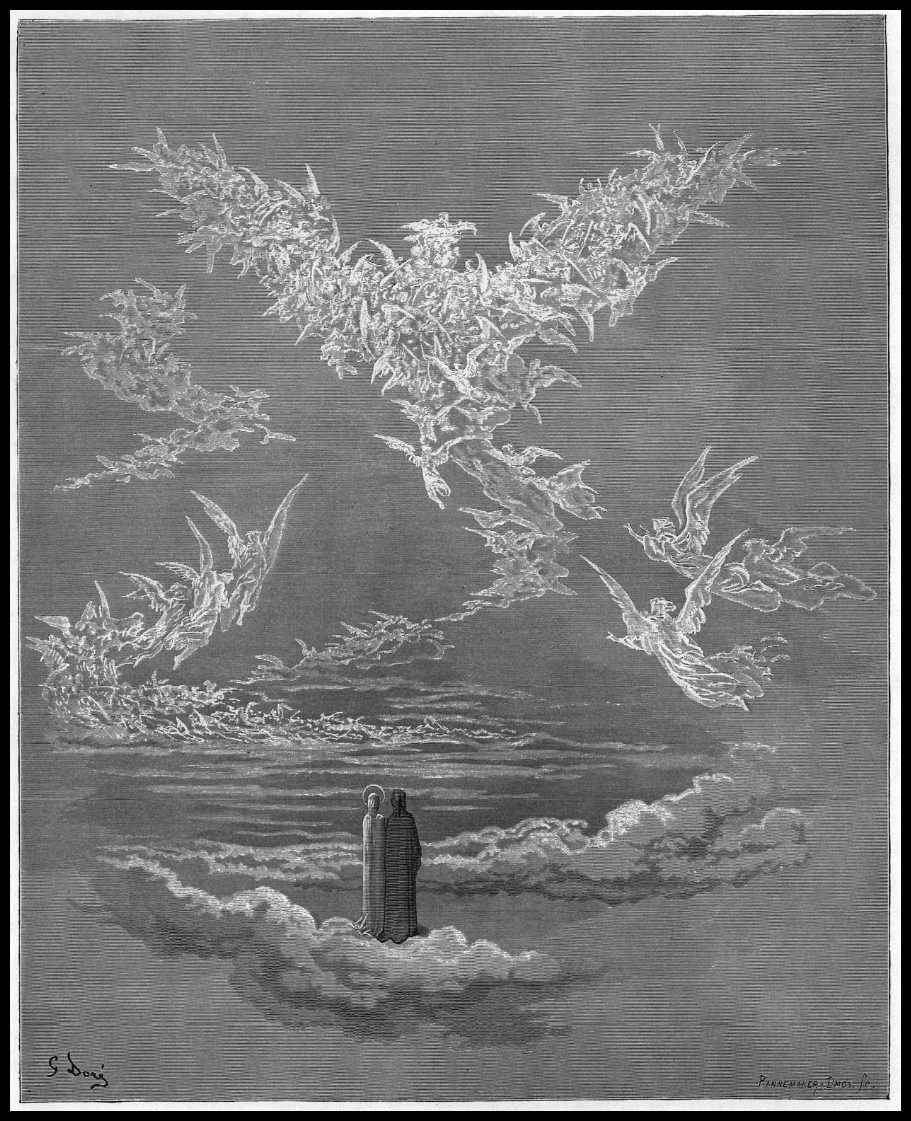
The Eagle discourses of Salvation, Faith, and Virtue. Condemnation of the vile Kings of A.D. 1300. Appeared before me with its wings outspread The beautiful image that
The beautiful image appeared before me
with its wings spread wide—
In sweet fulfillment, the interwoven souls
Made themselves jubilant—each appeared
A small ruby, burning with refracted sunlight
That blazed so bright it filled my eyes with fire.
View larger
THE EAGLE
“The beautiful image appeared before me / with its wings spread wide— / In sweet fulfillment, the interwoven souls”
What I must now recount has never been
Reported by any voice, written in any ink,
Or grasped by human imagination—
For I saw the eagle's beak both speak and heard it,
Uttering with its voice both "I" and "My"
When in its essence it was "We" and "Our."
And it began: "Being just and merciful,
I am exalted here to that glory
Which cannot be exceeded by desire.
On earth I left behind such memory
That even wicked people praise it there,
Though they refuse to follow its example."
Just as a single heat rises from many coals,
So from countless loves a single voice
Issued forth from that magnificent image.
I responded: "O eternal flowers
Of everlasting joy, you who make me
Perceive your countless fragrances as one—
Release me from the great fast that has held me
Starving for so long, finding no food on earth.
I know well that Divine Justice makes
Its perfect mirror in some other realm of heaven,
While yours perceives it without any veil.
You know how eagerly I prepare myself
To listen, and you know the doubt
That has been such an ancient hunger in me."
Like a falcon emerging from its hood,
Moving its head and beating its wings proudly,
Showing desire and preening itself fine—
So I saw that standard become, woven
With praises of divine grace,
Singing songs known only to those who rejoice there.
Then it began: "He who traced the compass
Around the world's outer edge, and within it
Designed so much that remains hidden and revealed,
Could never so imprint his power
Upon the entire universe that his Word
Would not remain infinitely beyond it.
This proves that the first proud being,
The summit of all creation,
Fell unripe by refusing to wait for light.
From this it's clear that every lesser nature
Is too small a vessel for that good
Which has no end and measures itself alone.
Therefore our vision—which must be
Some ray of that intelligence
That fills all things—cannot by its nature
Be powerful enough to avoid seeing
Its origin far beyond what appears to it.
So into eternal justice, the power of sight
Your world receives penetrates like an eye
Into the ocean—though it sees the bottom
Near shore, it cannot perceive it in the deep,
Yet it is there, hidden by the depths.
There is no light except from that serene
Clarity that is never overcast—
All else is darkness, shadow of the flesh,
Or its poison. Now the cavern is fully opened
That has concealed from you the living justice
You have questioned so persistently.
You asked: 'A man is born on the shore
Of the Indus, where no one can speak
Of Christ, or read, or write.
All his desires and actions
Are good, as far as human reason sees,
Without sin in life or speech.
He dies unbaptized and without faith—
Where is the justice that condemns him?
What is his fault if he does not believe?'
Who are you to sit in judgment
A thousand miles away
With the short sight of a single span?
Truly, for one who argues subtly with me,
If Scripture were not over you as guide,
There would be marvelous occasion for doubt.
O earthbound animals! O dull minds!
The primal will, good in itself,
Has never moved away from itself, the Supreme Good.
Only what accords with it is just—
No created good draws it toward itself,
But it, by radiating forth, creates that good."
Like a stork circling above her nest
After feeding her young ones,
While the fed chick gazes up at her,
So I lifted my face, and such
Became that blessed image, moving its wings
Driven by so many counsels.
Wheeling around, it sang: "As my notes
Are to you, who cannot understand them,
So is eternal judgment to mortals."
Those shining splendors of the Holy Spirit
Fell silent then, still within the standard
That made the Romans revered throughout the world.
It continued: "To this kingdom
No one has ever ascended without faith in Christ,
Before or after he was nailed to the tree.
But look—many cry 'Christ! Christ!'
Who at the judgment will be far less close
To him than some who never knew Christ's name.
Such Christians the Ethiopian will condemn
When the two companies are divided,
One forever rich, the other poor.
What might the Persians say to your kings
When they see that book opened
In which all their shameful deeds are written?
There will be seen, among Albert's works,
That which will soon set the pen in motion,
Making the kingdom of Prague desolate.
There will be seen the suffering he brings to the Seine
By counterfeiting coin—he who will die
By a wild boar's blow. There will be seen
The pride that kindles thirst,
Driving the Scot and Englishman so mad
They cannot stay within their own borders.
Seen too the luxury and soft living
Of Spain's king, and Bohemia's,
Who never knew nor wanted courage.
Seen the Cripple of Jerusalem—
His goodness marked by a single I
While the opposite earns an M.
Seen the greed and cowardice
Of him who guards the Island of Fire
Where Anchises ended his long life—
And to show how wretched he is,
His record will be written in abbreviations
That note much in little space.
To everyone will appear the foul deeds
Of uncle and brother, who dishonored
A nation so renowned, and two crowns.
He of Portugal and Norway will be known there,
And he of Rascia too, who saw
The Venetian coin to his sorrow.
O happy Hungary, if she lets herself
Be wronged no more! Happy Navarre,
If she arms herself with her surrounding hills!
Everyone should believe that even now,
As a foretaste of this, Nicosia and Famagosta
Lament and rage over their own beast
Who never departs from the others' flank."