O you pathetic nobility of bloodline!
If you make people take pride in you
down here where our hearts grow cold,
it will never surprise me—
for even in Heaven, where desire runs pure,
I too once boasted of you!
But truly you are a cloak that shrinks quickly,
so that unless we add new cloth each day,
time circles around you with his scissors.
With the formal "you" that Rome first allowed—
though her people no longer persist in it—
I began my words once more.
At this, Beatrice, standing a little apart
and smiling, looked like the lady who coughed
at Guinevere's first written sin.
And I began: "You are my ancestor.
You give me every courage to speak.
You lift me up so I become more than myself.
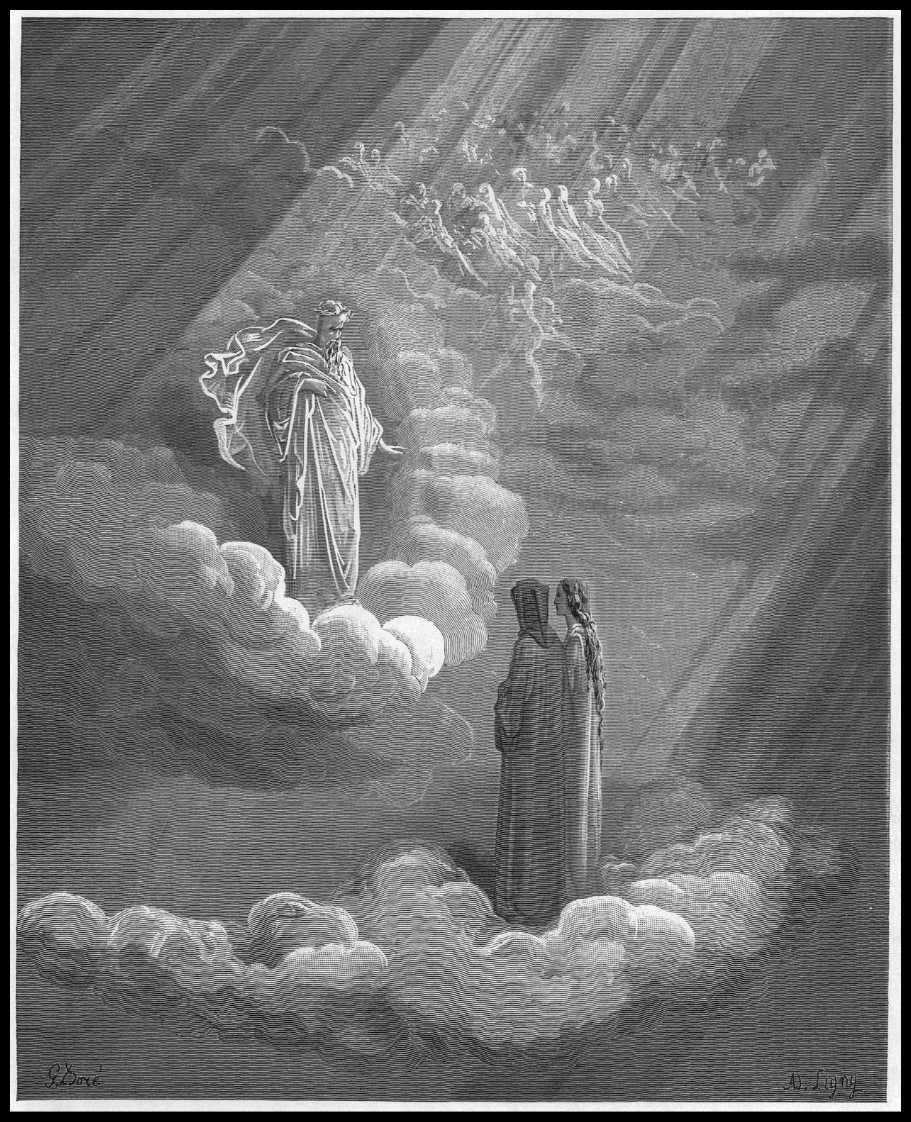
View larger
CACCIAGUIDA
“And I began: "You are my ancestor. / You give me every courage to speak. / You lift me up so I become more than myself.”
So many streams of gladness fill my mind
that it creates its own joy
because it can bear this weight and not burst.
So tell me, my beloved ancestral root:
Who were your forebears, and what years
were recorded in the chronicles of your youth?
Tell me about Saint John's sheepfold—
how large it was, and who were the people
within it worthy of the highest places."
Like a coal quickening to flame
when the wind blows, I saw that light
grow brilliant at my loving words.
And as it became more beautiful to my eyes,
with a voice sweeter and more tender—
but not in this modern dialect—it spoke:
"From the speaking of the 'Ave' to the birth
in which my mother, now a saint,
delivered herself of me, her burden,
this fire had returned five hundred
fifty-three times to its Lion
to rekindle itself beneath his paw.
My ancestors and I were born
where the runner in your annual race
first reaches the city's final district.
Let it suffice to hear this much of my elders—
who they were and where they came from,
silence is more gracious than speech.
All those who lived then between
Mars and the Baptist, fit to bear arms,
were one-fifth of those living now.
But the citizenry, now polluted
with Campi, Certaldo, and Figghine,
was pure even in its lowest craftsmen.
How much better to have those people
I speak of as neighbors, with your borders
at Galluzzo and Trespiano,
than to have them inside the city
and endure the stench of Aguglione's peasant
and that sharp-eyed schemer from Signa.
If the people who degenerate
most in all the world had not been
a stepmother to Caesar, but kind as a mother to her son,
some who become Florentines
and deal in trade and usury
would have returned to Simifonte,
where their grandfathers wandered as beggars.
Montemurlo would still have its Counts,
the Cerchi would be in Acone parish,
and perhaps the Buondelmonti in Valdigreve.
The mixing of peoples has always been
the source of cities' sickness,
like food that overloads the body.
A blind bull plunges down more recklessly
than a blind lamb, and one sword often cuts
better and deeper than five.
If you look at Luni and Urbisaglia,
how they have vanished, and how Chiusi
and Sinigaglia follow after them,
it will seem nothing strange or difficult
to hear how families waste away—
since even cities have their end.
All your things have their mortality,
just as you do, though in some things
that last long it stays hidden,
and human lives are brief.
As the turning of the moon's sphere
covers and uncovers shores without pause,
so fortune does the same with Florence.
Therefore it should not seem marvelous
what I will say about the great Florentines
whose fame is buried in the past.
I saw the Ughi, I saw the Catellini,
the Filippi, Greci, Ormanni, and Alberichi—
illustrious citizens even in decline.
I saw, as great as they were ancient,
the families of La Sannella and Arca,
Soldanier, Ardinghi, and Bostichi.
Near the gate that now bears
the weight of such fresh treachery
that it will soon be thrown from the ship,
lived the Ravignani, from whom descended
Count Guido and all who have since
taken great Bellincione's name.
He of La Pressa already knew statecraft,
and Galigajo already had
gilded hilt and pommel in his house.
Great already was the Vair column,
Sacchetti, Giuochi, Fifanti, and Barucci,
and Galli, and those who blush for the false bushel.
The stock that bore the Calfucci
was already great, and the Sizii
and Arrigucci were already chosen
for the curule chairs.
Oh, how I saw those ruined
by their own pride! And how the Golden Balls
adorned Florence with all their mighty deeds!
So too did the ancestors of those
who grow fat in consistory
whenever your church stands vacant.
That insolent race that follows like a dragon
whoever flees, but gentle as a lamb
to anyone who shows teeth or purse,
was already rising, but from low people—
so much so that Ubertin Donato
was displeased that his father-in-law made him their kin.
Already Caponsacco had descended
from Fiesole to the market,
and Giuda and Infangato were solid citizens.
I'll tell you something incredible but true:
people entered the small circuit through a gate
that took its name from the Della Pera family.
Everyone who bears the beautiful coat of arms
of the great baron whose name and fame
the feast of Thomas keeps fresh
received from him knighthood and privilege—
though today he who borders it with a band
allies himself with the common people.
Already there were Gualterotti and Importuni,
and the Borgo would be still more peaceful
if it had stayed unfed by new neighbors.
The house from which your weeping springs—
through righteous scorn that brought death among you
and ended your joyful life—
was honored, both itself and its allies.
O Buondelmonte, what an evil hour
when you fled that wedding at another's urging!
Many who now are sad would be rejoicing
if God had given you to the Ema
the first time you came to the city.
But it was fitting that Florence provide
a victim to that mutilated stone
guarding the bridge, in her last hour of peace.
With all these families and others beside them,
I saw Florence in such perfect rest
that she had no cause for tears.
With all these families I saw her people
so just and glorious that the lily
was never placed reversed upon the spear,
nor made red by division."