The multitude of people and their various wounds
had so overwhelmed my eyes
that they longed to stop and weep.
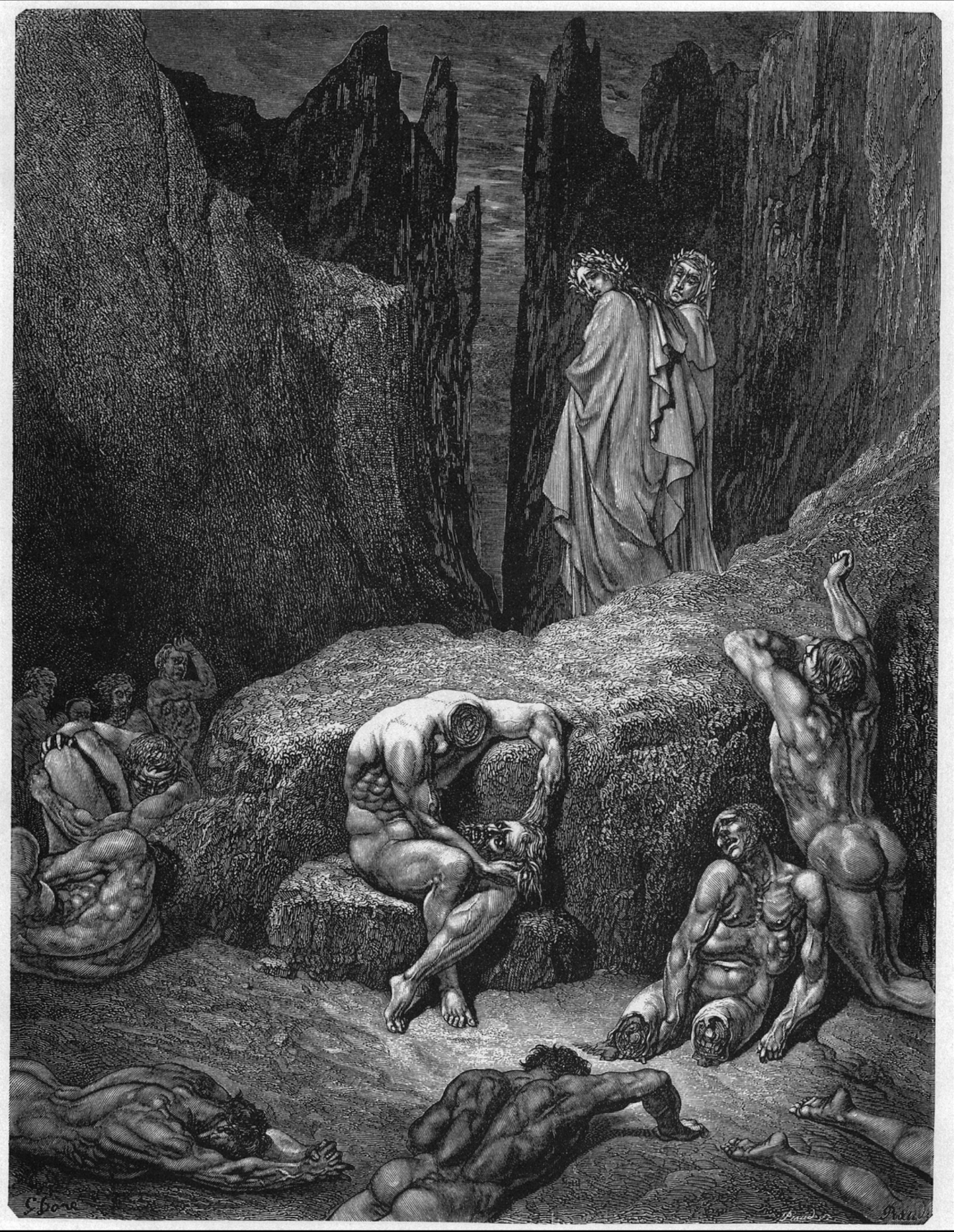
But Virgil said: "Why do you keep staring?
Why does your gaze remain fixed downward
There among the mournful, mutilated souls?
You haven't lingered like this at the other ditches.
Consider this, if you think you can count them all—
the valley winds for twenty-two miles around,
and the moon is already beneath our feet.
The time we have left grows short,
and there's more to see than what you're staring at."
View larger
GERI DEL BELLO
“But Virgil said: "Why do you keep staring? / Why does your gaze remain fixed downward / There among the mournful, mutilated souls?”
"If you had understood," I answered then,
"the reason why I looked so intently,
perhaps you would have pardoned a longer stay."
Meanwhile my guide moved on, and I followed,
already forming my reply as I added:
"In that pit where I fixed my gaze so steadily,
I believe a spirit of my own blood grieves
for the sin that costs so dearly down there."
Then my master said: "Don't let your thoughts
be troubled by him anymore.
Turn your attention elsewhere and leave him there.
I saw him at the foot of the little bridge,
pointing at you and shaking his finger
with fierce threats. I heard him called Geri del Bello.
You were so completely absorbed then
by the one who once ruled Altaforte
that you didn't look his way, and so he left."
"My guide," I said, "his violent death,
still unavenged by any who shares
in the family shame, filled him with scorn.
That's why he went away, I imagine,
without speaking to me,
and this makes me pity him all the more."
We spoke this way until we reached the first ledge
of the ridge that reveals the next valley
down to its bottom, if there were more light.
When we stood directly over the final cloister
of Malebolge, so that its suffering brothers
could show themselves to our sight,
strange lamentations pierced me through and through—
arrows barbed with such compassion
that I covered my ears with my hands.
Imagine the pain if all the diseases
from the hospitals of Valdichiana
between July and September,
and from Maremma and Sardinia,
were gathered in a single ditch—
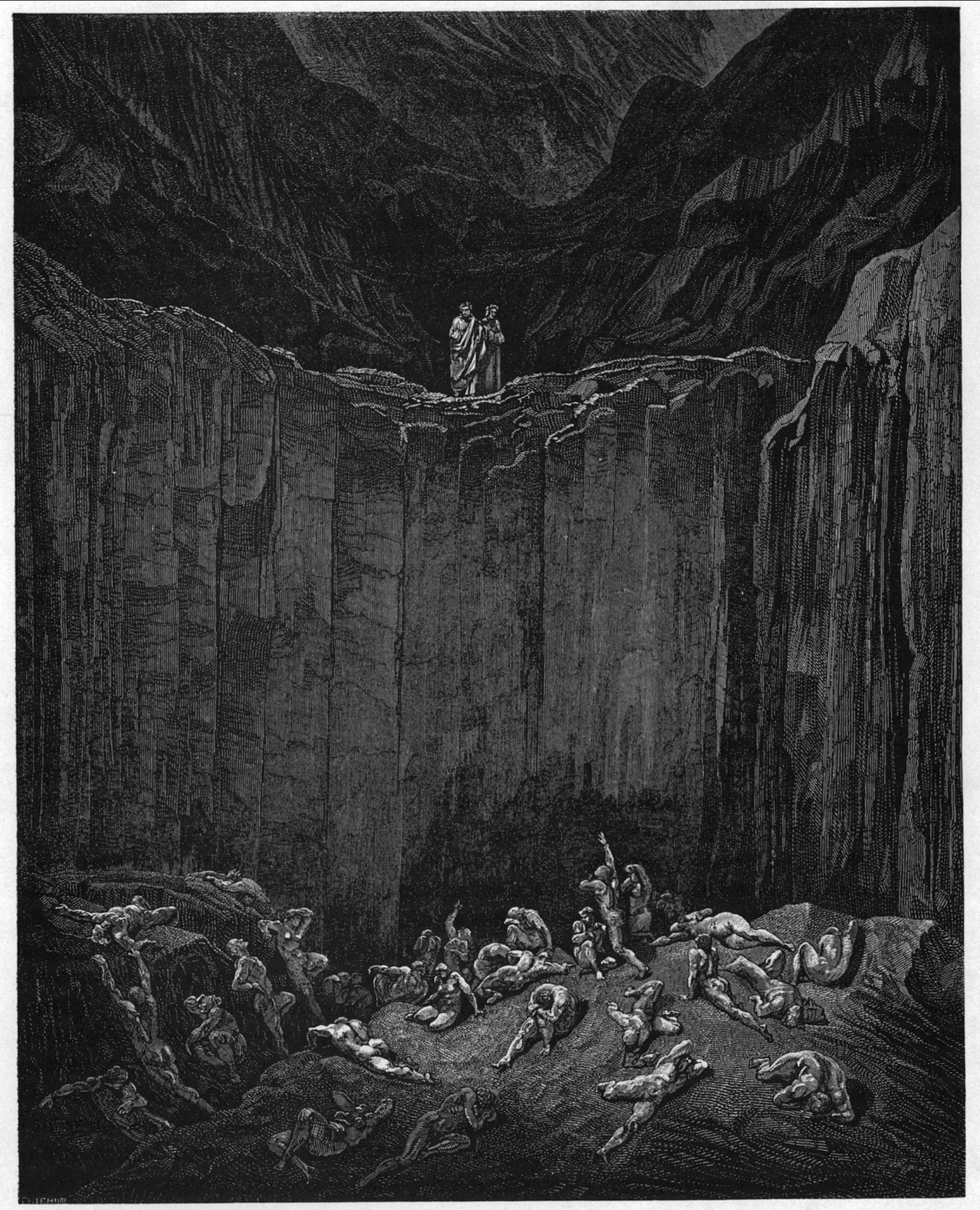
such was the agony here, and such a stench rose up
as usually comes from rotting limbs.
View larger
FORGERS
“such was the agony here, and such a stench rose up / as usually comes from rotting limbs.”
We descended to the farthest bank
of the long ridge, still keeping to the left,
and then my sight grew sharper
as I looked down toward the bottom, where the minister
of the high Lord—infallible Justice—
punishes the forgers she registers here.
I don't think there was a sadder sight
than when all the people of Aegina fell sick—
when the air was so thick with pestilence
that every creature, down to the smallest worm, died,
and afterward the ancient people,
as the poets tell us,
were restored from the seed of ants—
than seeing through that dark valley
the spirits languishing in scattered heaps.
One lay on another's belly, another on his back,
and others crawled along
shifting themselves down the wretched path.
Step by step we walked on without speaking,
watching and listening to the sick
who lacked the strength to lift their bodies.
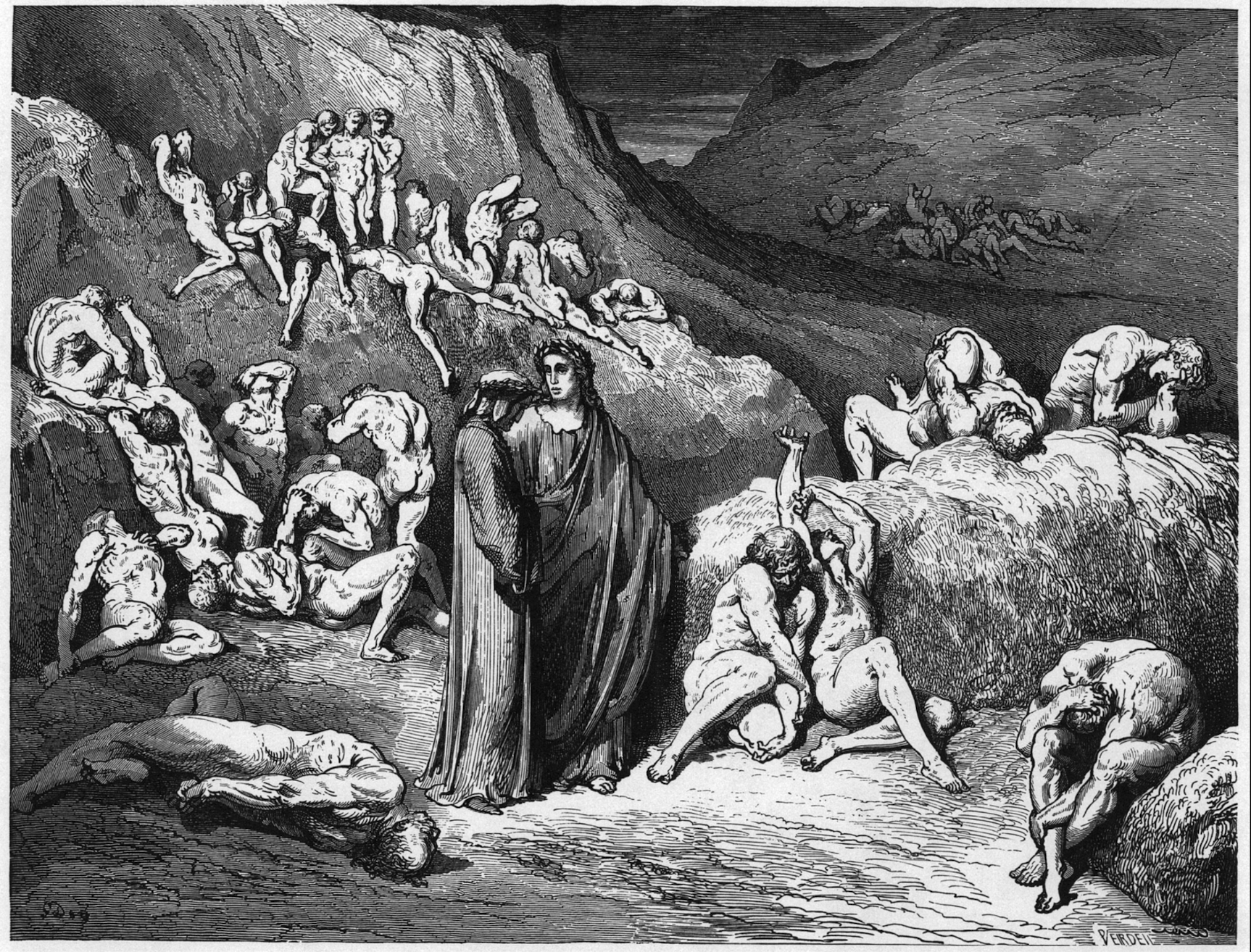
I saw two sitting propped against each other
like pans leaning together over a fire,
spotted from head to foot with scabs.
I never saw a stable boy wielding a currycomb
for his impatient master,
or someone forced to stay awake against his will,
scrape as furiously as each of these
clawed at himself with his nails
in the maddening itch that had no other cure.
View larger
FORGERS
“scrape as furiously as each of these / clawed at himself with his nails / in the maddening itch that had no other cure.”
Their nails dragged the scabs downward
the way a knife scrapes scales from a bream
or any other fish with large ones.
"You there, tearing yourself apart with your fingers,"
my leader began, addressing one of them,
"and sometimes making pincers of them—
tell us if there are any Italians
among those here, and may your nails suffice
for this work through all eternity."
"We are Italians, both of us you see so wasted,"
one replied, weeping, "but who are you
to ask about us?"
My guide answered: "I am one who descends
from ledge to ledge with this living man,
and I intend to show him Hell."
Then their mutual support broke apart,
and each turned toward me trembling,
along with others who heard his words echo.
My good master drew close to me, saying:
"Tell them whatever you wish."
Since he wanted me to speak, I began:
"So may your memory not fade away
from human minds in the first world,
but survive beneath many suns—
tell me who you are and from what people.
Don't let your foul and loathsome punishment
make you afraid to reveal yourselves to me."
"I was from Arezzo," one replied,
"and Albert of Siena had me burned.
But what I died for doesn't bring me here.
It's true I told him, speaking as a joke,
that I could rise into the air by flight,
and he—who had great curiosity but little sense—
wanted me to show him the art.
Simply because I couldn't make him Daedalus,
he had me burned by one who treated him like a son.
But to this last ditch of the ten,
for the alchemy I practiced in the world,
Minos, who cannot err, has condemned me."
I said to the poet: "Was there ever
a people as vain as the Sienese?
Certainly not the French, by far."
At this the other leper, who had heard me,
responded to my words: "Except for Stricca,
who knew the art of spending moderately,
and Niccolò, who first discovered
the costly custom of cloves
in that garden where such habits take root,
and except for the company among whom
Caccia d'Asciano squandered his vineyards and great woods,
and where Abbagliato displayed his wit!
But so you'll know who seconds you
against the Sienese, sharpen your eyes toward me
so my face can answer you clearly—
then you'll see I am the shade of Capocchio,
who falsified metals through alchemy.
You must remember, if I see you rightly,
how skilled an ape of nature I was."