Now one of the hard embankments carries us forward,
and the stream's vapor casts shadows overhead,
shielding both water and banks from the falling fire.
Just as the Flemings build their seawalls
between Cadsand and Bruges, fearing the floods
that hurl themselves against their shores,
and as the people of Padua raise dikes along the Brenta
to protect their towns and villages
before the spring thaw brings its heat—
so these embankments had been constructed,
though not as high or thick as those,
by whatever master architect had made them.
We had traveled so far from the dark wood
that even if I had turned around,
I could not have seen where it was,
when we encountered a company of souls
walking beside the dike. Each one
stared at us the way people do
in the evening light of a new moon,
squinting and sharpening their gaze
like an old tailor threading a needle.
Scrutinized by this strange family,
one of them recognized me. He seized
the hem of my robe and cried out, "What a wonder!"
When he stretched his arm toward me,
I fixed my eyes on his baked features
so intently that his scorched face
could not prevent my mind from knowing him.
Bending my face down to his, I replied,
"Are you here, Master Brunetto?"
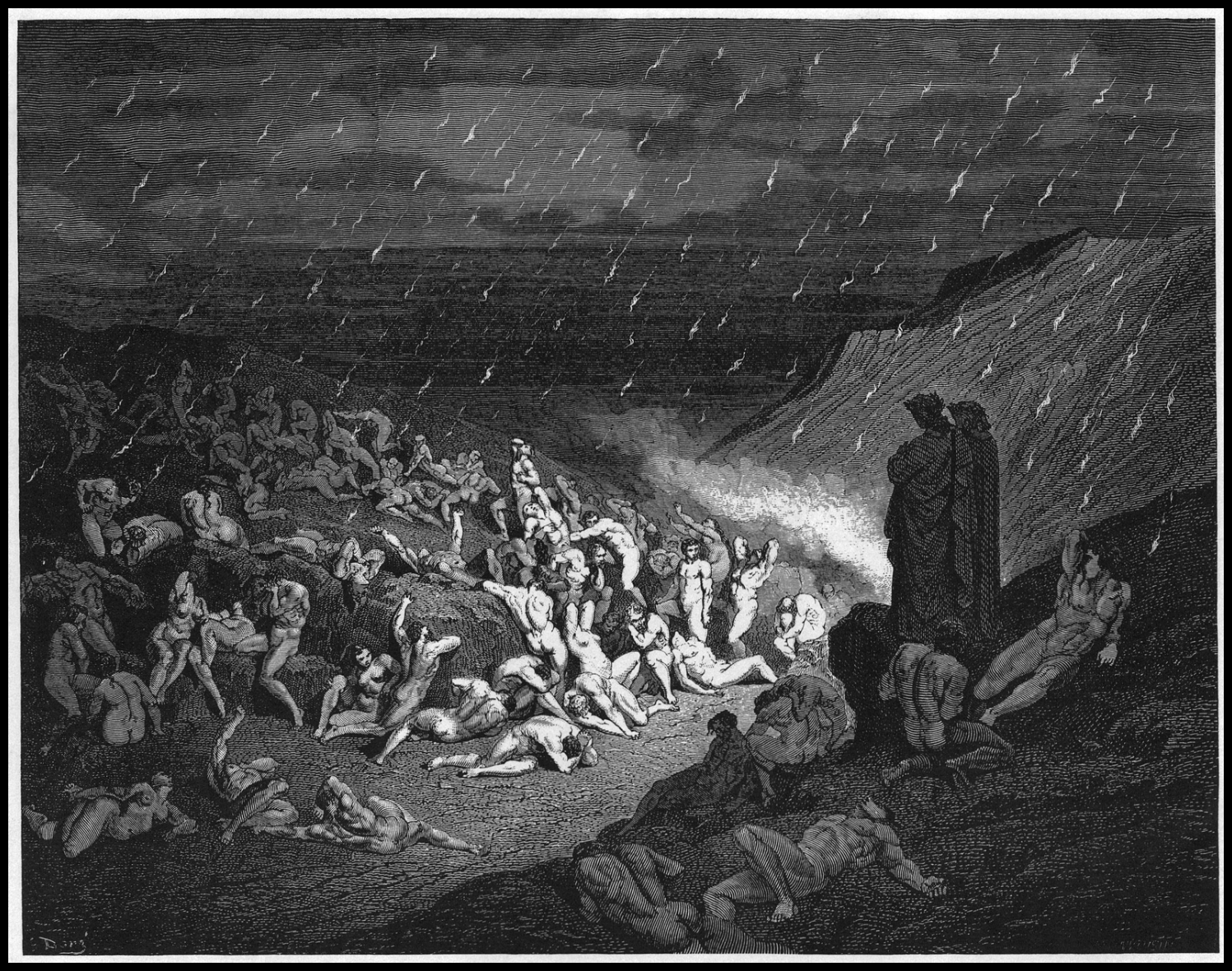
View larger
BRUNETTO LATINI
“"Are you here, Master Brunetto?"”
And he: "My son, do not let it displease you
if Brunetto Latini turns back with you
a little while and lets his group go on."
I said to him: "I ask this with all my heart,
and if you want me to sit down with you,
I will, if it pleases him who guides me."
"O son," he said, "whoever from this herd
stops even for a moment must then lie
a hundred years without relief from fire.
So keep walking—I'll follow at your hem,
and afterward I'll rejoin my band
that goes lamenting their eternal fate."
I didn't dare step down from the road
to walk level with him, but I kept
my head bowed like one who walks with reverence.
He began: "What fortune or what destiny
leads you down here before your final day?
And who is this one showing you the way?"
"Up there in the serene life above," I answered,
"I lost myself in a dark valley
before my years were complete.
Only yesterday morning I turned my back on it.
This one appeared as I was returning there,
and now leads me home along this path."
And he to me: "If you follow your star,
you cannot fail to reach a glorious harbor,
if I judged rightly in the beautiful life above.
And if I had not died so early,
seeing heaven so kind to you,
I would have encouraged you in your work.
But that ungrateful and malicious people
who descended long ago from Fiesole
and still taste of mountain stone and granite
will make themselves your enemy for your good deeds—
and rightly so, for among bitter sorb trees
the sweet fig has no business bearing fruit.
Ancient rumor calls them blind in the world—
a people greedy, envious, and proud.
Make sure you cleanse yourself of their customs.
Your destiny reserves such honor for you
that both parties will hunger for your allegiance,
but the grass will be far from the goat.
Let the beasts of Fiesole make their bed
of their own filth, and let them not touch the plant—
if any still springs up on their dung heap—
in which the sacred seed might yet revive
of those Romans who remained there
when it became a nest of such great evil."
"If my prayer were completely fulfilled," I replied,
"you would not yet be banished from human nature.
For fixed in my mind, and touching my heart now,
is the dear, kind, paternal image of you
when in the world, hour after hour,
you taught me how man makes himself eternal.
How grateful I am must be clear
in my words while I live.
What you tell me of my future I write down
and save to be interpreted with another text
by a Lady who can do so, if I reach her.
This much I want you to know:
as long as my conscience doesn't reproach me,
I'm ready for whatever Fortune brings.
This promise is not new to my ears.
So let Fortune spin her wheel however she pleases,
and the peasant swing his hoe."
At this my Master turned his head back
over his right shoulder, looked at me,
and said: "He listens well who takes note."
But I continued speaking with Master Brunetto,
asking him who were his most famous
and distinguished companions.
And he to me: "It's good to know some of them;
about others it would be better to stay silent,
for time is too short for so much talk.
Know, in sum, that they were all scholars
and great men of letters, of great fame,
stained in the world by the same sin.
Priscian walks there with that miserable crowd,
and Francesco d'Accorso. You could have seen there too,
if you had any appetite for such filth,
the one transferred by the Servant of Servants
from the Arno to the Bacchiglione,
where he left his sin-stretched body.
I would say more, but our walking and talking
can go on no longer, for I see
new smoke rising from the sand ahead.
People approach whom I cannot be with.
Let my Treasure be commended to you—
in it I still live, and I ask no more."
Then he turned back, and seemed like one
of those who run for the green cloth at Verona
across the field—and seemed to be among them
not the one who loses, but the one who wins.